
Few people know that a resin floor in an apartment is a smart flooring solution. In this article, we share the advantages and disadvantages of resin floors in apartments, the most important points of attention and a selection of inspiring projects. Read on to find out more.
The advantages and disadvantages of a resin floor in an apartment
The most important advantages and disadvantages of resin floors in apartments can be found in the table below:
| Advantages | Disadvantages |
| Sleek, seamless finish | Installation takes several days due to drying times |
| Stylish, timeless appearance | Not possible in every rental property |
| Matches diverse interior styles | Possible removal is time-intensive |
| Low floor thickness, adjustments to thresholds/doors rarely necessary | Some form of contact noise (with cement-bound version) |
| Suitable for underfloor heating and cooling | Not every resin floor is UV-resistant (aliphatic resin floors are) |
Most important points of attention for this match
Resin floors and apartments go together excellently! To also make this match a match made in heaven, we share three important points of attention below.
1. Acoustics
In apartments, strict requirements apply regarding noise nuisance, often in connection with VvE regulations. A 10 dB contact noise reduction standard is common to prevent contact noise nuisance for (lower) neighbors. With a correct subfloor, this noise reduction can already be realized. For this reason, resin floors in apartments are usually applied to a floating screed. (In new-build apartments, this is often already taken into account in the construction.)
By applying an extra acoustic membrane under the resin floor, the sound-damping effect can be further increased. With this special resin floor version, up to 15 dB of noise reduction can be realized.
In apartments, polyurethane (PU) resin floors are recommended. This type of resin floor is more sound-damping than a cement-bound resin floor.
2. User comfort
In terms of user comfort, cement-bound and PU resin floors are very similar. Both resin floor types are easy to keep free of dust and dirt, simple to clean with a pH-neutral cleaning agent and can be executed with underfloor heating.
In terms of walking comfort, the floors do differ from each other. Cement-bound resin floors offer comparable walking comfort to tiles. PU resin floors are naturally slightly elastic, which gives the floor a light cushioning.
3. Costs
Every resin floor project, regardless of the floor size, involves fixed start-up and execution activities. Think of specific application methods with associated processing times and logistical costs, such as call-out charges. For smaller resin floor surfaces, these actions represent a relatively larger part of the price per square meter. For resin floors, the following therefore applies: the larger the surface, the lower the costs per m2.
It pays to execute multiple rooms in an apartment with a resin floor at the same time. This results in a lower price per m2 and immediately creates more unity in the interior!
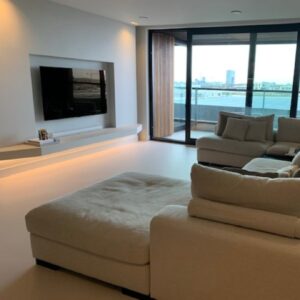
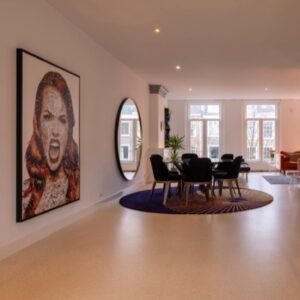
Inspiring resin floor projects in apartments
|
|
|
|

A TREU resin floor in your apartment?
A TREU resin floor is a sustainable and pleasant basis for every apartment. High-quality products are used for every layer to guarantee quality in the long term. This way, the floor remains a pleasure for everyone for years.
Curious about our collections?